Simple Drawing of Q 1933 Us Fighter Plane
| USS Akron (ZRS-4) | |
|---|---|
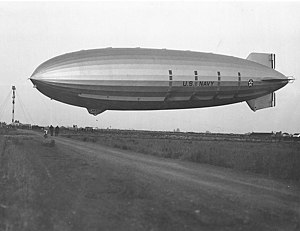 | |
| Akron budgeted the mooring mast at NAS Sunnyvale | |
| Manufacturer | Goodyear-Zeppelin Corporation, Akron, Ohio |
| Manufactured | 31 October 1929 (commenced) 8 August 1931 (launched) |
| Serial | ZRS-4 |
| First flying | 23 September 1931 |
| Owners and operators | United States Navy |
| In service | 27 October 1931 (commissioned) |
| Last flight | 4 April 1933 |
| Flights | 73 |
| Full hours | 1695.8 |
| Aircraft carried | v x Curtiss F9C 'Sparrowhawk',[one] Consolidated N2Y-1, Waco XJW-1 |
| Fate | Crashed off coast of New Jersey, 4 April 1933 |
USS Akron (ZRS-iv) was a helium-filled rigid airship of the U.S. Navy, the atomic number 82 ship of her class, which operated betwixt September 1931 and Apr 1933. She was the world'southward offset purpose-congenital flying aircraft carrier, carrying F9C Sparrowhawk fighter planes, which could be launched and recovered while she was in flight. With an overall length of 785 ft (239 m), Akron and her sister send Macon were among the largest flight objects e'er built. Although LZ 129 Hindenburg and LZ 130 Graf Zeppelin 2 were some 18 ft (v.5 m) longer and slightly more than voluminous, the 2 German airships were filled with hydrogen, and then the US Navy craft yet holds the world record for the largest helium-filled airships.[2]
Akron was destroyed in a thunderstorm off the declension of New Jersey on the morning of 4 Apr 1933, killing 73 of the 76 crewmen and passengers. The accident involved the greatest loss of life in whatsoever airship crash.
Technical description [edit]

Akron nether construction in the Goodyear Airdock at Akron, Ohio in Nov 1930. Note the three-dimensional, deep rings.
The airship's skeleton was built of the new lightweight blend duralumin 17-SRT.[3] The frame introduced several novel features compared with traditional Zeppelin designs. Rather than existence single-girder diamond trusses with radial wire bracing, the chief rings of Akron were cocky-supporting deep frames: triangular Warren trusses 'curled' round to form a ring. Though much heavier than conventional rings, the deep rings promised to be much stronger, a significant attraction to the navy afterwards the in-flight break up of the earlier conventional airships R38/ZR-2 and ZR-1 Shenandoah.[4] The inherent strength of these frames allowed the principal designer, Karl Arnstein, to dispense with the internal cruciform construction used by Zeppelin to back up the fins of their ships. Instead, the fins of Akron were cantilevered: mounted entirely externally to the main structure.[5] Graf Zeppelin, Graf Zeppelin Two, and Hindenburg used a supplementary axial keel along the hull centerline. However, the Akron used three keels, ane running along the top of the hull and 1 each side, 45 degrees up from the lower centreline. Each keel provided a walkway running almost the entire length of the ship. The electric and telephone wiring, command cables, 110 fuel tanks, 44 h2o anchor bags, 8 engine rooms, engines, transmissions, and water-recovery devices were placed along the lower keels. Helium, instead of flammable hydrogen, immune the engines to be placed inside the hull, improving streamlining. A generator room, with two Westinghouse d.c. generators powered by a 30-h.p. internal combustion engine, was forward of the No. 7 engine room.[half dozen] : 36, 187–197
The main rings were spaced at 22.v m (74 ft) and between each pair were three intermediate rings of lighter construction. In keeping with conventional practise, 'station numbers' on the airship were measured in meters from zilch at the rudder postal service, positive forward and negative aft. Thus the tip of the tail was at station −23.75 and the nose mooring spindle was at station 210.75. Each ring frame formed a polygon with 36 corners and these (and their associated longitudinal girders) were numbered from 1 (at the lesser centre) to 18 (at the top heart) port and starboard.[7] Thus a position on the hull could be referred to, for case, as "half-dozen port at station 102.five" (the number 1 engine room).
While Germany, France and Britain used goldbeater'south skin to gas-proof their gasbags, Akron used Goodyear Tire and Rubber's rubberised cotton wool, heavier just much cheaper and more durable. One-half the gas cells used an experimental cotton-based fabric impregnated with a gelatin-latex compound. This was more expensive than the rubberised cotton simply lighter than goldbeater'due south skin. It was and so successful that all the gasbags of Macon were made from it.[8] In that location were 12 gas cells, numbered 0 to XI, using Roman numerals and starting from the tail.[9] While the 'air volume' of the hull was 7,401,260 cu ft (209,580 chiliad3), the full volume of the gas cells at 100 percent fill was 6,850,000 cu ft (194,000 m3). At a normal 95 percentage fill with helium of standard purity, the 6,500,000 cu ft (180,000 mthree) of gas would yield a gross elevator of 403,000 lb (183,000 kg). Given a structure deadweight of 242,356 lb (109,931 kg),[10] this gives a useful lift of 160,644 lb (72,867 kg) available for fuel, lubricants, ballast, crew, supplies and military load (including the skyhook airplanes)
Eight Maybach VL Two 560 hp (420 kW) gasoline engines were mounted within the hull.[11] Each engine turned a ii-bladed, 16 ft 4 in (4.98 m) bore, fixed pitch, wooden propeller via a driveshaft and bevel gearing which immune the propeller to swivel from the vertical plane to the horizontal.[12] With the engines' ability to reverse, this allowed thrust to be practical frontwards, aft, up or down.[13] It appears from photographs that the 4 propellers on each side were contra-rotating, each ane turning the opposite way to the ane ahead of information technology. Thus it would appear that the designers were aware that running the propellers in the air disturbed by the one alee was not ideal. While the external engine pods of other airships allowed the thrust lines to be staggered, placing all four engine rooms on each side of the ship forth the lower keel resulted in Akron 's propellers all existence in line. This was to prove problematical in service, inducing considerable vibration, specially noticeable in the emergency command position in the lower fin. By 1933, Akron had 2 of her propellers replaced by more advanced, footing-adaptable, iii-bladed, metal propellers.[14] These promised a operation increment and were adopted equally standard for Macon.
The outer embrace was of cotton cloth, treated with 4 coats of clear and two coats of aluminum pigmented cellulose dope. The total area of the skin was 330,000 sq ft (31,000 one thousand2) and it weighed, after doping, 113,000 lb (51,000 kg).[fifteen]
The prominent dark vertical bands on the hull were condensers of the system designed to recover water from the engines' frazzle for buoyancy compensation. In-flight fuel consumption continuously reduces an airship's weight and changes in the temperature of the lifting gas can do the aforementioned. Normally, expensive helium has to exist valved off to compensate and any style of avoiding this is desirable. In theory, a h2o recovery system such equally this tin can produce ane lb of ballast water for every lb of fuel burned, though this is unlikely to be achieved in practice.[13]
Akron could carry up to 20,700 US gal (78,000 L) of gasoline (126,000 lb (57,000 kg)) in 110 separate tanks which were distributed along the lower keels to preserve the ship's trim, giving her a normal range of 5,940 nmi (half dozen,840 mi; 11,000 km) at cruising speed.[16] Theoretical maximum ballast water capacity was 223,000 lb (101,000 kg) in 44 numberless, once again distributed along her length, though normal ballast load at unmasting was 20,000 lb (9,100 kg).[xv] Maximum ballast was never an option, considering a full fuel and ballast load would have left only 4,600 lb (2,100 kg) lifting chapters for aircraft, crew, and supplies, and each fully loaded F9C fighter alone weighed 2,800 lb (1,300 kg).
The heart of the send, and her sole reason for existing, was the airplane hangar and trapeze organization. Aft of the control motorcar, in bay VII, between frames 125 and 141.25, was a compartment large enough to accommodate up to 5 F9C Sparrowhawk airplanes. Still, two structural girders partially obstructed Akron 's aftmost hangar trophy, limiting its capacity to three airplanes (one in each forward corner of the hangar and 1 on the trapeze). A modification to remove this design flaw was pending at the time of the ship'southward loss.[17]
The F9C was non the ideal choice, existence designed every bit a 'conventional' carrier-borne fighter. It was heavily congenital to withstand carrier landings, downward visibility was non very good and it initially lacked an effective radio. But the primary function of Akron 'south airplanes was long-range naval scouting. What was really needed was a stable, fast, lightweight scouting plane with a long range,[xviii] but none existed capable of fitting between the structural members and into the airship's hangar, every bit the F9C could.
The trapeze was lowered through the T-shaped door in the bottom of the ship and into the slipstream, with an aeroplane attached to the crossbar by the 'skyhook' higher up its meridian wing, its pilot on lath and its engine running. The pilot tripped the hook and the aeroplane savage away from the ship. On his render, he positioned himself below the trapeze and climbed up until he could fly his skyhook onto the batten, at which signal it automatically latched shut. Now, with the engine idling, the trapeze and airplane were raised into the hangar, the airplane pilot cutting his engine as he passed through the door. One time inside, the airplane was transferred from the trapeze to a trolley, running on an overhead 'monorail' system past which it could exist shunted into one of the four corners of the hangar to be refueled and re-armed. Having a single trapeze raised two problems: information technology limited the rate at which airplanes could exist launched and recovered and any fault in the trapeze would go out any airborne scouts with nowhere to state. The solution was a second, stock-still trapeze permanently rigged farther aft along the bottom of the ship at station 102.five and known equally the 'perch'. By 1933 a perch was fitted and in employ. Three more perches were planned (at stations 57.5, lxxx and 147.five) but these were never fitted.[17]
Akron revived an idea used, and eventually rejected, by the German Navy zeppelins during World War I: the spähkorb or 'spy handbasket'.[xix] The "angel basket" or "sub-deject ascertainment car", allowed the balloon to remain hidden in a deject layer, while still observing the enemy below. The small-scale car, rather like an airplane fuselage without wings, could be lowered on a 1000 foot long cable. The observer on lath communicated with the ship past phone. In practice, the device was unstable, almost looping over the airship during its simply test flight.[6]
During the design stage, in 1929, the navy requested an alteration to the fins. Information technology was considered desirable for the bottom of the lower fin to be visible from the control car. Charles E. Rosendahl had witnessed, from the control room, Graf Zeppelin almost snagging her fin on loftier-tension ability lines during her heavy take off into an unsuspected merely very marked temperature inversion from Mines Field, Los Angeles at the start of the last leg of her round-the-world flight earlier that year.[20] The design modify would also allow direct vision betwixt the primary control car and the emergency command position in the lower fin. The control car was moved 8 ft (2.4 m) aft and all the fins were shortened and deepened. The leading edge root of the fins no longer coincided with a main (deep) ring and instead the foremost attachment was now to an intermediate band at frame 28.75. This accomplished the required visibility, improved low-speed controllability, due to the increased bridge of the control surfaces, and simplified stress calculations, by reducing the number of fin attachment points. The designers and the navy's inspectors, led by the very experienced Charles P Burgess, were entirely satisfied with the revised stress calculations. Still, this amending has been the subject of much criticism as an "inherent defect" in the design and is ofttimes alleged to have been a major factor in the loss of Akron 'due south sister ship Macon.[21] Construction for both ships amounted to $8,800,000 (in 1931 dollars) with the Akron accounting $5,538,400 of the total.[22]
Construction and commissioning [edit]
Construction of ZRS-4 was begun on 31 Oct 1929 at the Goodyear Airdock in Akron, Ohio by the Goodyear-Zeppelin Corporation.[23] Because she was larger than any airship previously congenital in the US, a special hangar was constructed.[24] Chief Designer Karl Arnstein and a team of experienced German airship engineers instructed and supported design and construction of both U.S. Navy airships USS Akron and USS Macon.[25]
On 7 Nov 1929, Rear Admiral William A. Moffett, the Chief of the U.S. Navy'southward Bureau of Aeronautics, collection the "golden rivet" into the main ring of "ZRS4". Erection of the hull sections began in March 1930. Secretarial assistant of the Navy Charles Francis Adams chose the proper noun Akron (for the metropolis nigh where she was existence built), and Assistant Secretarial assistant of the Navy Ernest Lee Jahncke announced it in May 1930.[6] : 33
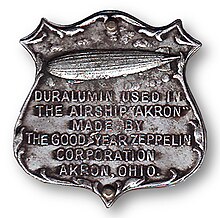
Sample of the duralumin from which the frame of USS Akron was built
On 8 August 1931, Akron was launched (floated free of the hangar flooring) and christened by First Lady Lou Henry Hoover, the wife of the President of the U.s.a., Herbert Clark Hoover. The maiden flight of Akron took place effectually Cleveland on the afternoon of 23 September with Secretary of the Navy Adams and Rear Admiral Moffett on board. The airship fabricated x trial flights, including a 2000-mile journey, over 48 hours, to St. Louis, Chicago, and Milwaukee. On 21 October Akron left the Goodyear Zeppelin Air Dock for the Naval Air Station (NAS), with Lieutenant Commander Charles E. Rosendahl in command, arriving the adjacent twenty-four hour period. On Navy Day, 27 October 1931, the Akron was commissioned every bit a Navy vessel.[6] : 37–43
History of service [edit]
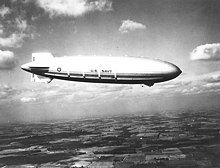
The maiden voyage of Akron on 2 November 1931, showing her 4 starboard propellers. The engines' water reclaiming devices appear as white strips to a higher place each propeller. The emergency rear control cabin is visible in the lower fin.
Maiden voyage [edit]
On two November 1931, Akron departed on her first prowl downwardly the eastern seaboard to Washington, D.C. On 3 November the "Akron" took to the air with 207 persons on lath. This sit-in was to prove that in an emergency airships could provide express simply high speed airlift of troops to outlying possessions. Over the weeks that followed, some 300 hours aloft were logged in a series of flights, including a 46-hour endurance flying to Mobile, Alabama, and back. The return leg of the trip was made via the valleys of the Mississippi River and the Ohio River.[6] : 47–49
Participation in a search exercise (January 1932) [edit]
Film of Akron operating over Chesapeake Bay in early 1932, including footage of the ship mooring to the airship tender USSPatoka
On the morning of 9 Jan 1932, Akron departed from Lakehurst to piece of work with the Scouting Fleet on a search do. Proceeding to the coast of North Carolina, Akron headed out over the Atlantic where she was assigned to find a group of destroyers jump for Guantánamo Bay, Cuba. In one case these were located, the airship was to shadow them and report their movements. Leaving the coast of North Carolina at about vii:21 on the morning of x January, the airship proceeded s, but bad weather prevented sighting the destroyers (contact with them was missed at 12:40 EST, although their crews had sighted Akron) and eventually shaped a course toward the Commonwealth of the bahamas by late afternoon. Heading northwesterly into the night, Akron then changed course shortly before midnight and proceeded to the southeast. Ultimately, at 9:08 am on 11 January, the balloon succeeded in spotting the light cruiser USSRaleigh and 12 destroyers, positively identifying them on the eastern horizon two minutes later. Sighting a second group of destroyers presently thereafter, Akron was released from the evaluation most 10:00 a.chiliad., having achieved a "qualified success" in the initial test with the Scouting Fleet, only the operation could have been better with radio detection finding equipment, and scout planes.[6] : 49–51
Every bit the historian Richard K Smith wrote in his definitive study, The Airships Akron and Macon, "...consideration given to the weather condition, elapsing of flight, a rail of more 3,000 mi (four,800 km) flown, her textile deficiencies, and the rudimentary character of aerial navigation at that appointment, the Akron 's performance was remarkable. There was non a armed forces airplane in the world in 1932 which could have given the same performance, operating from the same base."[26]
Offset accident (Feb 1932) [edit]
Akron was to have taken part in Fleet Problem Xiii, but an blow at Lakehurst on 22 Feb 1932 prevented her participation. While the balloon was being taken from her hangar, the tail came loose from her moorings, was caught past the air current, and struck the ground.[27] The heaviest damage was confined to the lower fin surface area, which required repair. Also, ground handling fittings had been torn from the main frame, necessitating further repairs. Akron was not certified as airworthy over again until later in the jump. Her next operation took place on 28 April, when she fabricated a nine-hour flight with Rear Admiral Moffett and Secretary of the Navy Adams aboard.[6] : 53–55
Equally a result of this accident, a turntable with a walking beam on tracks powered by electric mine locomotives was developed to secure the tail and plough the send even in high winds so that she could exist pulled into the massive hangar at Lakehurst.[28]
Testing of the "spy basket" [edit]
Soon after returning to Lakehurst to disembark her distinguished passengers, Akron took off again to comport a test of the "spy basket"—something like a minor plane fuselage suspended beneath the airship that would enable an observer to serve as the transport'due south "eyes" below the clouds while the transport herself remained out of sight above them. The first fourth dimension the basket was tried (with sandbags aboard instead of a man), it oscillated so violently that it put the whole ship in danger. The basket proved "frighteningly unstable", swooping from one side of the airship to the other before the startled gaze of Akron 'southward officers and men and reaching equally high as the ship's equator.[nineteen] Though it was later improved by adding a ventral stabilizing fin, the spybasket was never used again.[29]
Experimental apply as a "flying shipping carrier" [edit]

Akron and Macon (which was still under construction) were regarded as potential "flying aircraft carriers", carrying parasite fighters for reconnaissance. On three May 1932, Akron cruised over the coast of New Jersey with Rear Admiral George C. Day, and the Board of Inspection and Survey, on board, and for the first fourth dimension tested the "trapeze" installation for in-flight treatment of aircraft. The aviators who carried out those historic "landings"—first with a Consolidated N2Y trainer and and then with the prototype Curtiss XF9C-i Sparrowhawk—were Lieutenant D. Ward Harrigan and Lieutenant Howard L. Young. The following day, Akron carried out another demonstration flight, this time with members of the Firm Committee on Naval Diplomacy on board; this time, Lieutenants Harrigan and Young gave the lawmakers a demonstration of Akron 's aircraft hook-on ability.[6] : 55–56
"Declension-to-declension" flying and second blow (May 1932) [edit]

Comprehend carried on the May 1932 "Coast to Declension" flight and after autographed by the simply iii survivors of the April 1933 crash of USS Akron
Following the conclusion of those trial flights, Akron departed from Lakehurst, New Jersey on eight May 1932, for the American west coast. The airship proceeded down the eastern seaboard to Georgia and and then across the southern gulf states, standing over Texas and Arizona. En route to Sunnyvale, California, Akron reached Army camp Kearny in San Diego on the morning of 11 May and attempted to moor. Since neither trained footing handlers nor specialized mooring equipment were present, the landing at Camp Kearny was fraught with danger. By the time the coiffure started the evaluation, the helium gas had been warmed by sunlight, increasing elevator. Lightened by forty brusk tons (36 t), the amount of fuel spent during the transcontinental trip, Akron was now uncontrollably light.[half dozen] : 56–57

Nevertheless pictures from 11 May 1932 incident: the two pictures on the left and the picture at far right are of Seaman Cowart; the motion picture second from right shows Henton and Edsall before their fatal fall
The mooring cable was cut to avert a catastrophic nose-stand by the errant airship which floated upward. Virtually of the mooring crew—predominantly "boot" seamen from the Naval Training Station San Diego—released their lines although four did not. One let go at about 15 ft (4.half dozen m) and suffered a broken arm while the three others were carried further aloft. Of these, Aviation Carpenter's Mate third Class Robert H. Edsall and Apprentice Seaman Nigel M. Henton presently plunged to their deaths while Apprentice Seaman C. 1000. "Bud" Cowart held on to his line and then secured himself to information technology[xxx] before beingness hoisted on board the airship an hour after.[31] Akron moored at Camp Kearny later that 24-hour interval before proceeding to Sunnyvale, California. Footage from the accident appears in the motion-picture show Encounters with Disaster, released in 1979 and produced past Dominicus Classic Pictures.
W Declension flights [edit]
Over the weeks that followed, Akron "showed the flag" on the Due west Coast of the United States, ranging as far north as the Canada–Usa border earlier returning southward in time to exercise again with the Scouting Fleet. Serving equally part of the "Green Force", the Akron attempted to locate the "White Force". Although opposed by Vought O2U Corsair floatplanes from "enemy" warships, the balloon located the opposing forces in simply 22 hours, a fact not lost upon some of the participants in the practise in subsequent critiques.[6] : 58–59

In need of repairs, Akron departed from Sunnyvale on 11 June 1932 bound for Lakehurst, New Jersey, on a render trip that was sprinkled with difficulties, generally because of unfavorable weather, and having to fly at pressure height while crossing the mountains. Akron arrived on 15 June subsequently a "long and sometimes harrowing" aerial voyage.[half dozen] : 61–62
Akron next underwent a period of voyage repairs earlier taking office in July in a search for Curlew, a yacht which had failed to reach port at the end of a race to the island of Bermuda. The yacht was later discovered safe off Nantucket.[32] She then resumed operations capturing aircraft on the "trapeze" equipment. Admiral Moffett again boarded Akron on 20 July, but the next day left the airship in i of her N2Y-1s which took him back to Lakehurst afterwards a severe storm had delayed the airship'southward own return to base of operations.[half dozen] : 65–66
Farther tests as "flying shipping carrier" [edit]
Akron entered a new stage of her career that summertime of 1932, engaging in intense experimentation with the revolutionary "trapeze" and a total complement of F9C-2s. A key element of the entrance into that new phase was a new commanding officer, Commander Alger Dresel.[6] : 63–65
Third blow (August 1932) [edit]
Another accident hampered training on 22 August when Akron 'southward tail fin became fouled by a axle in Lakehurst'southward massive Hangar No ane after a premature lodge to embark towing the ship out of the mooring circle. However, rapid repairs enabled eight more flights over the Atlantic during the last iii months of 1932. These operations involved intensive work with the trapeze and the F9C-2s, too as the drilling of lookouts and gun crews.[6] : 66–67
Among the tasks undertaken were the maintenance of two aircraft patrolling and scouting on Akron 's flanks. During a seven-hour period on 18 November 1932, the airship and a trio of planes searched a sector 100 mi wide.[6] : 67
Return to the fleet [edit]
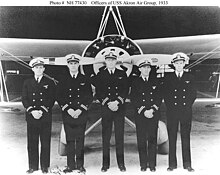
Pilot officers of USS Akron Air Group, 1933 (50 to r): Lt(JG) Robert Due west. Lawson, Lt Harold B. Miller, Lt Frederick M. Trapnell, Lt Howard L. Immature, Lt(JG) Frederick N. Kivette
Afterward local operations out of Lakehurst for the remainder of 1932, Akron was set up to resume operations with the fleet. On the afternoon of 3 January 1933, Commander Frank C. McCord relieved Commander Dresel equally commanding officeholder, the latter condign the outset commanding officer of Akron 's sister ship Macon, whose construction was well-nigh complete. Within hours, Akron headed south downward the eastern seaboard toward Florida where, later on refueling at the Naval Reserve Aviation Base, Opa-locka, Florida, near Miami, the next day proceeded to Guantánamo Bay for an inspection of base of operations sites. At this time the N2Y-1s were used to provide aerial "taxi" service to ferry members of the inspection party back and forth.[half-dozen] : 73
Soon thereafter, Akron returned to Lakehurst for local operations which were interrupted by a two-calendar week overhaul and poor weather. In March, she carried out intensive preparation with an aviation unit of measurement of F9C-2s, honing hook-on skills. During the grade of these operations, an overfly of Washington DC was made 4 March 1933, the mean solar day Franklin D. Roosevelt outset took the oath of office every bit President of the United states.[6] : 74
On 11 March, Akron departed Lakehurst bound for Panama stopping briefly en route at Opa-locka before proceeding on to Balboa where an inspection political party looked over a potential air base site. While returning n, the balloon paused at Opa-locka again for local operations exercising gun crews, with the N2Y-1s serving as targets, earlier getting underway for Lakehurst on 22 March.[6] : 74–75
Loss [edit]

Franked USS Akron penalisation encompass with 1933 Memorial Day cachet autographed by its merely three survivors, and postmarked at Lakehurst on 24 June 1933, the mean solar day Macon starting time arrived in that location
On the evening of 3 April 1933, Akron cast off from the mooring mast to operate along the coast of New England, assisting in the calibration of radio management finder stations. Rear Admiral Moffett was over again on lath along with his aide, Commander Henry Barton Cecil, Commander Fred T. Berry, the commanding officeholder of NAS Lakehurst, and Lieutenant Colonel Alfred F. Masury, U.South. Army Reserve, a guest of the admiral, the vice-president of Mack Trucks, and a strong proponent of the potential civilian uses of rigid airships.[6] : 77–78
After casting off at nineteen:28, Akron soon encountered fog and and so astringent weather, which did not improve when the airship passed over Barnegat Calorie-free, New Bailiwick of jersey,[33] at 22:00. According to Richard Smith, "Unknown to the men on board the Akron, they were flying ahead of i of the virtually tearing stormfronts to sweep the North Atlantic States in ten years. It would soon envelop them." Enveloped in fog, increased lightning and heavy rain, information technology became extremely turbulent at 00:15. The Akron began a rapid nose-downwardly descent, reaching 1100 anxiety while still falling. Ballast was dumped, which stabilized the ship at 700 feet, and climbed dorsum to 1600 feet cruising altitude. And so a 2nd violent descent sent the Akron downwards at 14 anxiety per second. "Landing stations" alerted the crew, every bit the ship descended tail-down. The lower fin struck the body of water, h2o entered the fin, and the stern was dragged under. The engines pulled the ship into a olfactory organ-high attitude, then the Akron stalled, and crashed into the sea.[vi] : 78–80
Akron bankrupt up rapidly and sank in the stormy Atlantic. The crew of the nearby German language merchant ship Phoebus saw lights descending toward the ocean at nigh 00:23 and contradistinct course to starboard to investigate, with her captain believing that he was witnessing an plane crash. At 00:55, executive officer Lieutenant Commander Herbert V. Wiley was pulled from the h2o while the transport's boat picked up iii more than men: Principal Radioman Robert West. Copeland, Boatswain'due south Mate 2d Grade Richard Due east. Bargain, and Aviation Metalsmith Second Class Moody E. Erwin. Despite bogus respiration, Copeland never regained consciousness, and he died aboard Phoebus.[half dozen] : lxxx
Although the German language sailors spotted four or five other men in the h2o, they did not know their ship had chanced upon the crash of Akron until Lt. Commander Wiley regained consciousness half an hour after being rescued. The crew of Phoebus combed the ocean in boats for over 5 hours in a fruitless search for more survivors. The Navy stuffed J-3—sent out to join the search—also crashed, with the loss of two men.[34]

The cruiser USSPortland was 1 of several ships that searched for survivors from the Akron
The U.S. Declension Guard cutter Tucker—the showtime American vessel on the scene—arrived at 06:00, taking the airship's survivors and the body of Copeland on board. Among the other ships combing the area for survivors were the heavy cruiser Portland, the destroyer Cole, the Coast Guard cutter Mojave, and the Coast Guard destroyers McDougal and Chase, too as two Coast Guard shipping. The line-fishing vessel Grace F from Gloucester, Massachusetts, also assisted in the search, using her seining gear in an endeavor to recover bodies.[35]
Most casualties had been caused by drowning and hypothermia, since the crew had not been issued life jackets, and there had not been time to deploy the single life raft. The accident left 73 dead, and just three survivors. Wiley, standing next to the two other survivors, gave a cursory account on 6 April.[36]
Aftermath of loss [edit]
Akron 'southward loss spelled the beginning of the terminate for the rigid airship in the U.S. Navy, especially since one of her leading proponents, Rear Admiral William A. Moffett, was amid the dead. President Roosevelt said, "The loss of the Akron with her crew of gallant officers and men is a national disaster. I grieve with the Nation and peculiarly with the wives and families of the men who were lost. Ships can exist replaced, but the Nation can ill beget to lose such men equally Rear Admiral William A. Moffett and his shipmates who died with him upholding to the finish the finest traditions of the United States Navy." The loss of the Akron was the largest loss of life in any airship crash.[37]
Macon and other airships received life jackets to avert a repetition of this tragedy. When Macon was damaged in a storm in 1935 and subsequently sank subsequently landing in the ocean, 70 of the 72 crew were saved.
The songwriter Bob Miller wrote and recorded a song, "The Crash of the Akron", within 1 twenty-four hour period of the disaster.[38]
In the summertime of 2003, the U.S. submarine NR-1 surveyed the wreck site and performed sonar imaging of the Akron's girders.[39]
Assessment [edit]
For numerous reasons, in the opinion of U.South. naval aviation historian Richard K. Smith,[40] Akron never got the chance to show what she was capable of. Initially, the thought had been to use her as a watch for the fleet, simply as the German Navy zeppelins had been used during World State of war I, with her airplanes beingness simply useful auxiliaries capable of extending her range of vision or of defending her against attacking enemy aircraft.[41] Gradually, in the minds of the more forward-thinking officers familiar with airship and scouting fleet operations, that was reversed, and she and Macon came to be regarded as aircraft carriers, whose sole job was to go the scouting airplanes to the search area and and so to support them in their flights.[42] [43] The mothership herself should stay in the groundwork, out of sight of enemy surface units, and act simply as a mobile advanced base for the airplanes, which should do all of the actual searching.[44] Any shipping carrier could exercise that, but but an airship could do information technology so quickly since her speed was at least twice that of a surface ship, enabling her to become to the scene or be switched from flank to flank quickly. Yet, it was an experimental ship, a epitome, and it took time for the doctrine and suitable tactics to evolve. It also took fourth dimension to develop the techniques of navigating, controlling, and coordinating the scouts. At first, developments were hampered past inadequate radio equipment,[45] equally well equally the difficulties encountered past the scout pilots in navigating, scouting, and communicating from their cramped open cockpits.[46]
Some politicians, some senior officers, and some sections of the press seemed predisposed to guess the airship experiment a failure without regard to the bear witness.[47] Even within the Navy's Bureau of Aeronautics, many opposed spending so much on a single asset.[40] Smith also asserts that political pressure within and outside the navy led to the ship being pushed too early to attempt too much.[48] Little assart seems to take been made for the fact that this was a prototype, an experimental organisation, and that tactics for her apply were being developed "on the hoof." Equally a result, the balloon'south performance in armada exercises was not all that some had hoped and gave an exaggerated impression of the transport'due south vulnerability and failed to demonstrate her strengths.[49]
Specifications (as congenital) [edit]
Data based on the book The Story of the Balloon by Hugh Allen.[l]
Full general characteristics
- Crew: 60
- Length: 785 ft (239 m)
- Diameter: 132 ft xi in (forty m)
- Elevation: 146.five ft (44.7 g)
- Volume: 6,500,000 cu ft (180,000 m3)
- Gross weight: 403,000 lb (182,798 kg)
- Useful elevator: 182,000 lb (83,000 kg)
- Powerplant: eight × Maybach VL II 12-cyl water-cooled, inline engines, 560 hp (420 kW) each
- Propellers: 2-bladed fixed-pitch, rotatable wooden propellers
Performance
- Maximum speed: 73 kn (84 mph, 135 km/h)
- Cruise speed: 43 kn (l mph, lxxx km/h)
- Range: 9,190 nmi (10,580 mi, 17,030 km) at 50 miles per hour (80 km/h)
Armament
- Guns: eight x.30-cal motorcar guns
See also [edit]
- List of airship accidents
- Listing of airships of the United States Navy
- Rigid airship
Notes [edit]
- ^ "U.South. Navy Airships U.Due south.South. Akron (ZRS-4) and U.s.S. Macon (ZRS-5)". airships.net.
- ^ Smith, Richard K (1965). The Airships Akron & Macon: Flying Aircraft Carriers of the The states Navy. Annapolis, Maryland: United States Naval Plant. p. 210. ISBN0-87021-065-3.
- ^ Smith (1965). p. 181
- ^ Smith (1965). p. 187
- ^ Smith (1965). pp. 161 & 189
- ^ a b c d eastward f 1000 h i j m 50 yard due north o p q r south t u Smith, Richard (1965). The Airships Akron & Macon, The Flying Aircraft Carriers of the United States Navy. Annapolis, Maryland: Naval Constitute Press. p. 55. ISBN0870210653.
- ^ Smith (1965). p. 191
- ^ Smith (1965). p. 196
- ^ Smith (1965). pp. 182 & 191
- ^ Smith (1965). pp. 181 & 183
- ^ Claw 1976. p. 47
- ^ Summit Memory. U.Southward.Southward. Akron – Propeller. Retrieved 2008-07-22
- ^ a b Smith (1965). p. 193
- ^ Smith (1965). p. 75
- ^ a b Smith (1965). p. 182
- ^ Smith (1965). pp. 180–183
- ^ a b Smith (1965). p. 67
- ^ Smith (1965). pp. 27 & 201
- ^ a b Smith (1965). p. 55
- ^ Rosendahl (1932). pp. 194 et al
- ^ Smith (1965). p. 197
- ^ "The Southeast Missourian - Google News Archive Search". news.google.com . Retrieved 13 November 2021.
- ^ "Goodyear-Zeppelin Corporation, Facts About the Globe'southward Largest Airship Factory & Dock". via Akron-Top County Public Library. Retrieved 15 Nov 2008.
- ^ "A Nine Acre Nest For Dirigibles" Popular Scientific discipline Monthly, September 1929
- ^ Smith (1965). pp. 7, 8, 34 & 161
- ^ Smith (1965). p. 51
- ^ Sudden Gale Akron at Lakehurst NJ 1932/02/22, Universal Newspaper Newsreel, 1932, retrieved 20 February 2009
- ^ Corporation, Bonnier (1 Apr 1932). "Popular Science". Bonnier Corporation.
- ^ Smith (1965). pp. 133–135
- ^ "Heed Traps: The fatal fault of hanging on too long – Update". Jeff Wise . Retrieved 8 January 2019.
- ^ "USN Aircraft-USS Akron (ZRS-iv) – Events". History.navy.mil. Archived from the original on v Feb 2012. Retrieved 24 March 2014.
- ^ "Sport: Cruise of the Curlew". Time. 18 July 1932. Archived from the original on 27 Oct 2010. Retrieved 27 May 2010.
- ^ "Forgotten U.S. airship crash recalled lxxx years later". NJ.com. Associated Press. 13 March 2013. Retrieved 24 March 2014.
- ^ "David Due east. Cummins, Lieutenant Commander, Us Navy". Arlington National Cemetery. Retrieved 20 February 2009.
- ^ Gloucester Times. Apr 1933
- ^ Commander Describes Akron Tragedy While Navy Search Goes On 1933/04/06, Universal Newspaper Newsreel, 1933, retrieved xx February 2009
- ^ "10 Worst Airship Disasters in History". Retrieved 3 March 2013.
- ^ "Come All You Truthful People, a Story to Hear". Newsweek . Retrieved 25 Jan 2008.
- ^ Fell, USN, JO1 (SW / AW) Mark A. "NR-ane's Summer of Armed services Missions and Scientific Exploration". Undersea Warfare. No. 2, Winter 2003. United States Navy.
The get-go stop for NR-1 and its coiffure was off the coast of New Jersey at the site where the Navy dirigible USS Akron (ZRS-4) crashed before long subsequently midnight on 4 April 1933. [...] NR-1 made a unmarried pass forth the wreckage of the airship at a depth of approximately 120 anxiety, while the crew obtained imagery of the hulk using the submarine'south side-looking sonars. "It was neat to see something of historical significance similar that," McKelvey said. "Akron was actually a very technologically avant-garde weapon arrangement for the Navy at the time. "We were able to get some very practiced images of the wreck," McKelvey connected, "merely the visibility was too poor to do very extensive surveys. We saw that the actual send itself was built of an aluminum alloy called duraluminum and nosotros were able to see some of the girders. They looked like I-beams with holes drilled out of them to make them lighter and still retain their strength."
- ^ a b Smith (1965). p 171
- ^ Smith (1965). p 177
- ^ Report by Senior Aviator, HTA Unit to CO, Akron ZRS4/A4-3, 15 December 1932, Record Group 72, BuAer General Correspondence (1925–1942), Box 5592, United states National Archives
- ^ Smith (1965). pp 51 & 107
- ^ Smith (1965). pp 28 & 29
- ^ Smith (1965). pp 49 & 51
- ^ Smith (1965). p 69
- ^ Smith (1965). pp. 51, 53, 55, 59, etc.
- ^ Smith (1965). p. 45 et al (peculiarly p 56)
- ^ Smith (1965). pp 59, 171 et al
- ^ The Story of the Balloon, Hugh Allen, p. 76, viewable on Google Books
References [edit]
- Hook, Thomas, Heaven Ship: the Akron Era. Annapolis, Md: Airshow Publishers, 1976.
- Robinson, Douglas H, and Charles L. Keller. "Up Ship!": U.S. Navy Rigid Airships 1919–1935. Annapolis, Maryland: The states Naval Establish, 1982. ISBN 0-87021-738-0
- Daze, James R, U.Due south. Navy Airships 1915–1962, Edgewater, Florida: Atlantis Productions, 2001. ISBN 0-9639743-eight-6
- Smith, Richard K, The Airships Akron & Macon: Flight Aircraft Carriers of the United states of america Navy., Annapolis, Maryland: United States Naval Institute, 1965. ISBN 0-87021-065-3
- Rosendahl, C East, Up Ship! New York, NY: Dodd, Mead and Company,1932.
- Section of the Navy, Naval Historical Eye. USS Akron. Retrieved 5 May 2005.
External links [edit]
- Construction of the USS Akron, Part One. University of Akron. 1931. Retrieved 16 August 2016.
- Construction of the USS Akron, Role Two. Academy of Akron. 1931. Retrieved 16 August 2016.
- USS Akron and USS Macon at Airships.cyberspace
- USS Akron page from the Lexicon of American Naval Fighting Ships
- USS Akron and Macon
- Images of the U.S.S. Akron from the Summit Retention Project
- Herbert V. Wiley Captain USN USS Due west Virginia 1944–1945
- "Akron Disaster 1933/04/04". Universal Newspaper Newsreel.
- "Navy Air Giant Handles Easy As A Yacht", Dec 1931, Popular Mechanics
- "World's Biggest Airship To Fly In May", Feb 1931, Popular Scientific discipline big detailed article with cutaway cartoon of Akron
- Commander Describes Akron Tragedy While Navy Search Goes On 1933/04/06 (1933). Universal Newsreel. 1933. Retrieved 22 February 2012.
- Sentry Encounters with Disaster (1979) on the Net Archive
This article incorporates text from the public domain Lexicon of American Naval Fighting Ships.
Coordinates: 39°27′7.8″North 73°42′27.00″Westward / 39.452167°Due north 73.7075000°Westward / 39.452167; -73.7075000
Source: https://en.wikipedia.org/wiki/USS_Akron
0 Response to "Simple Drawing of Q 1933 Us Fighter Plane"
Post a Comment