Plan Playground Drawing for Kids
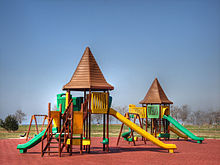
A playground, playpark, or play area is a place designed to provide an environment for children that facilitates play, typically outdoors. While a playground is normally designed for children, some are designed for other age groups, or people with disabilities. A playground might exclude children below a sure age.
Modern playgrounds ofttimes have recreational equipment such equally the seesaw, merry-go-round, swingset, slide, jungle gym, chin-up bars, sandbox, spring rider, trapeze rings, playhouses, and mazes, many of which help children develop physical coordination, strength, and flexibility, as well every bit providing recreation and enjoyment and supporting social and emotional development. Mutual in modern playgrounds are play structures that link many unlike pieces of equipment.
Playgrounds often besides have facilities for playing informal games of adult sports, such as a baseball diamond, a skating arena, a basketball game court, or a tether ball.
Public playground equipment installed in the play areas of parks, schools, childcare facilities, institutions, multiple family dwellings, restaurants, resorts, and recreational developments, and other areas of public use.
A blazon of playground called a playscape is designed to provide a safe environment for play in a natural setting.
History

Seesaw with a crowd of children playing
Through history, children played in their villages and neighbourhoods, especially in the streets and lanes nearly their homes.[1] [ii] [iii]
In the 19th century, developmental psychologists such as Friedrich Fröbel proposed playgrounds as a developmental aid, or to imbue children with a sense of fair play and good manners. In Deutschland, a few playgrounds were erected in connection to schools,[iv] the first purpose-built public-access playground was opened in a park in Manchester, England in 1859.[five]
Response to Mass motorisation

However, information technology was just in the early 20th century, equally the street lost its part as the default public space and became planned for apply by motor cars, that momentum built to remove children from the new dangers and confine them to segregated areas to play. In the United states, organisations such as the National Highway Protective Guild highlighted the numbers killed by automobiles, and urged the cosmos of playgrounds, aiming to free streets for vehicles rather than children'due south play.[six] [7] The Outdoor Recreation League provided funds to erect playgrounds on parkland, especially following the 1901 publication of a written report on numbers of children existence run down by cars in New York City.[8]

In tandem with the new concern about the danger of roads, educational theories of play, including past Herbert Spencer and John Dewey inspired the emergence of the reformist playground move, which argued that playgrounds had educational value, improved attention in class, enhanced concrete health, and reduced truancy.[9] Interventionist programs such every bit by the child savers sought to move children into controlled areas to limit 'delinquency'.[two] Meanwhile, at schools and settlement houses for poorer children with limited admission to education, health services and daycare, playgrounds were included to support these institutions' goal of keeping children condom and out of trouble.[eight]
One of the first playgrounds in the United States was built in San Francisco'due south Golden Gate Park in 1887.[10] In 1906 the Playground Association of America was founded and a year later Luther Gulick became president.[eleven] Information technology later became the National Recreation Clan and then the National Recreation and Park Association.[12] Urging the need for playgrounds, former President Theodore Roosevelt stated in 1907:
- City streets are unsatisfactory playgrounds for children because of the danger, because most good games are against the law, because they are too hot in summertime, and because in crowded sections of the city they are apt to be schools of criminal offence. Neither do small-scale dorsum yards nor ornamental grass plots see the needs of any but the very small children. Older children who would play vigorous games must accept places especially set aside for them; and, since play is a fundamental need, playgrounds should be provided for every child every bit much as schools. This means that they must be distributed over the cities in such a fashion as to be within walking distance of every boy and girl, every bit most children can not beget to pay carfare.[xiii]
In post war London the landscape architect and children's rights campaigner Lady Allen of Hurtwood introduced and popularised the concept of the 'junk playground' - where the equipment was constructed from the recycled junk and rubble left over from the Blitz. She campaigned for facilities for children growing up in the new loftier-rise developments in Britain's cities and wrote a series of illustrated books on the subject area of playgrounds, and at least one book on run a risk playgrounds, spaces for free creativity by children, which helped the idea spread worldwide.[14]
Playgrounds in the Soviet Union
Playgrounds were an integral part of urban culture in the USSR. In the 1970s and 1980s, in that location were playgrounds in most every park in many Soviet cities. Playground apparatus was reasonably standard all over the country; most of them consisted of metal bars with relatively few wooden parts, and were manufactured in state-owned factories. Some of the most common constructions were the carousel, sphere, seesaw, rocket, bridge, etc.
Design
-

Combination playground structure for pocket-size children; slides, climbers (stairs in this instance), playhouse
-

-

A "pirate transport" in Pelle Hermanni park in Pori, Finland
-
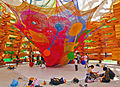
Playground at Fuji-Hakone-Izu National Park
-
-

The "proton playground" at Fermilab includes a Bubble Chamber model and encourages children to follow a path resembling protons in a collider.
Playground design is influenced by the intended purpose and audition. Separate play areas might be offered to accommodate very young children. Unmarried, big, open parks tend to not to be used past older schoolgirls or less aggressive children, because at that place is little opportunity for them to escape more aggressive children.[15] Past contrast, a park that offers multiple play areas is used equally by boys and girls.
Effects on kid development
Professionals recognize that the social skills that children develop on the playground ofttimes become lifelong skill sets that are carried forward into their adulthood. Independent research concludes that playgrounds are among the nearly important environments for children outside the dwelling house. Most forms of play are essential for healthy evolution, but free, spontaneous play—the kind that occurs on playgrounds—is the well-nigh beneficial type of play.
Heady, engaging and challenging playground equipment is of import to go along children happy while still developing their learning abilities. These should be developed in lodge to suit dissimilar groups of children for different stages of learning, such every bit specialist playground equipment for plant nursery & pre-school children instruction them basic numeracy & vocabulary, to building a child'south creativity and imagination with part play panels or puzzles.

There is a general consensus that concrete activeness reduces the gamble of psychological problems in children and fosters their self-esteem.[ commendation needed ] The American Principal Medical Officer'due south report (Department of Wellness, 2004), stated that a review of available research suggests that the health benefits of physical activity in children are predominantly seen in the amelioration of risk factors for disease, avoidance of weight proceeds, achieving a peak os mass and mental well-being.
Exercise programmes "may have brusk term beneficial effects on cocky esteem in children and adolescents"[sixteen] although high-quality trials are lacking.[16]
Commentators contend that the quality of a kid's exercise feel can bear on their cocky-esteem. Ajzen TPB (1991) promotes the notion that children's self-esteem is enhanced through the encouragement of physical mastery and self-evolution. It tin can be seen that playgrounds provide an platonic opportunity for children to master concrete skills, such as learning to swing, residuum and climb. Personal evolution may be gained through the enhancement of skills, such every bit playing, communicating and cooperating with other children and adults in the playground.
It can also exist seen that public and private playgrounds act as a preventative health mensurate amongst young people because they promote physical activity at a stage in children'due south lives when they are agile and non notwithstanding at run a risk from opting out of physical action.[ citation needed ]
Children take devised many playground games and pastimes. Merely because playgrounds are usually subject to adult supervision and oversight, immature children's street civilisation often struggles to fully thrive in that location. Research by Robin Moore[17] ended shown that playgrounds demand to be balanced with marginal areas that (to adults) appear to be derelict or wasteground but to children they are areas that they can claim for themselves, ideally a wooded area or field.
For many children, it is their favorite time of day when they get to exist on the playground for free time or recess. It acts equally a release for them from the pressures of learning during the twenty-four hours. They know that time on the playground is their own time.[ citation needed ]
A type of playground called a playscape can provide children with the necessary feeling of buying that Moore describes above. Playscapes tin can as well provide parents with the assurance of their kid's prophylactic and wellbeing, which may non exist prevalent in an open field or wooded area.
Funding

A playground under construction in Ystad, Sweden in 2016
In the UK, several organisations exist that help provide funding for schools and local authorities to construct playgrounds. These include the Biffa Laurels, which provides funding under the Small Grants Scheme; Funding Central, which offers back up for voluntary organisations and social enterprises; and the Community Structure Fund, a flagship programme by Norfolk County Quango.[18]

A playground being built for a homeowner's backyard as part of a handyman project. Modern playgrounds tin have many options likewise swingsets, including sandboxes, rope-climbs, tic-tac-toe games, a fort with dormer roofs and a chimney, a slide, and other amenities.
Safety
Safe, in the context of playgrounds, is generally understood as the prevention of injuries. Gamble aversion and fear of lawsuits on the part of the adults who pattern playgrounds prioritizes injury prevention to a higher place other factors, such as cost or developmental do good to the users.[19] It is important that children gradually develop the skill of gamble cess, and a completely rubber environment does not allow that.
Sometimes the safety of playgrounds is disputed in school or among regulators. Over at to the lowest degree the last xx years, the kinds of equipment to be found in playgrounds has inverse, oft towards safer equipment built with plastic. For case, an older jungle gym might be constructed entirely from steel bars, while newer ones tend to accept a minimal steel framework while providing a web of nylon ropes for children to climb on. Playgrounds with equipment that children may fall off often utilise rubber mulch on the basis to help cushion the impact.[xx]
Playgrounds are besides made differently for different age groups. Often schools take a playground that is taller and more advanced for older schoolchildren and a lower playground with less gamble of falling for younger children.
Prophylactic discussions do non normally include an evaluation of the unintended consequences of injury prevention, such as older children who do not exercise at the playground because the playground is too boring.[21]
Safety efforts sometimes paradoxically increase the likelihood and severity of injuries because of how people cull to use playground equipment. For example, older children may choose to climb on the exterior of a "safe" merely boring play structure, rather than using it the way the designers intended. Similarly, rather than letting young children play on playground slides past themselves, some injury-balky parents seat the children on the developed'south lap and go downwards the slide together.[22] This seems safer at first glance, but if the child's shoe catches on the edge of the slide, this arrangement frequently results in the kid'due south leg being broken.[22] If the child had been permitted to use the slide independently, then this injury would non happen, because when the shoe caught, the kid would have stopped sliding rather than being propelled down the slide by the adult's weight.[22]
Besides apropos the condom of playgrounds is the fabric in which they are congenital. Wooden playgrounds human action every bit a more natural environs for the children to play simply tin can crusade even more minor injuries. Slivers are the main concern when building with woods material. Wet weather is also a threat to children playing on wooden structures. Most woods are treated and do non wear terribly fast, but with enough rain, wooden playgrounds can become slippery and dangerous for children to be on.
Regulation
In the Usa, the Consumer Product Condom Committee and the American National Standards Institute have created a Standardized Document and Training System for certification of Playground Safe Inspectors. These regulations are nationwide and provide a footing for safe playground installation and maintenance practices. ASTM F1487-07 deals with specific requirements regarding issues such as play ground layout, use zones, and various exam criteria for determining play ground safety. ASTM F2373 covers public apply play equipment for children 6–24 months former. This information tin exist applied effectively only by a trained C.P.S.I. A National List of Trained Playground Safety Inspectors is bachelor for many states. A Certified Playground Safe Inspector (CPSI) is a career that was developed by the National Playground Safety Institute (NPSI) and is recognized nationally past the National Recreation and Park Association or N.R.P.A. (Some data sources offering interactive examples[23] of playground equipment that violates CPSC guidelines.)
In Australia, Standards Australia is responsible for the publication of the playground safety Standards AS/NS4422, AS/NZS4486.1 and AS4685 Parts one to 6. The University of Engineering Sydney is responsible for the preparation and accreditation of playground inspectors.[24] The Register of Playground Inspectors Commonwealth of australia lists all the individuals who accept been certified to inspector playgrounds within Australia.[25]
European Standards EN 1177 specifies the requirements for surfaces used in playgrounds. For each cloth blazon and height of equipment information technology specifies a minimum depth of material required.[26] EN 1176 covers playground equipment standards.[27] [28] In the UK, playground inspectors tin sit the examinations of the Register of Play Inspectors International at the three required levels - routine, operational and annual. Annual inspectors are able to undertake the post-installation inspections recommended past EN 1176.
Prevention strategies
Considering the majority of playground injuries are due to falls from equipment, injury prevention efforts are primarily directed at reducing the likelihood of a child falling and reducing the likelihood of a astringent injury if the child does fall. This is done by:
- reducing the maximum fall height of equipment, primarily by reducing the overall height of anything a kid might climb on or into;
- reducing the likelihood of falling from equipment, through using barriers, discouraging climbing, and making upper surfaces inconvenient or uncomfortable for climbing or sitting on; and
- installing a more flexible surface under and effectually play equipment, and so that a child who falls is less likely to break a bone.
How effective these strategies are at preventing injuries is debated by experts, considering when playgrounds are made from padded materials, children often take more risks.[21] [29]
Playground injury
Each year in the United States, emergency departments treat more than 200,000 children ages xiv and younger for playground-related injuries.[30] [31] Approximately 156,040 (75.eight%) of the 1999 injuries occurred on equipment designed for public utilise; 46,930 (22.viii%) occurred on equipment designed for dwelling use; and ii,880 (1.iv%) occurred on homemade playground equipment (primarily rope swings).
- Percentage of injuries involving public equipment
- Well-nigh 46% occurred in schools.
- About 31% occurred in public parks.
- Almost 10% occurred in commercial childcare centers.
- Near 3% occurred in domicile childcare.
- Nigh 3% occurred in apartment complexes.
- Nigh 2% occurred in fast nutrient restaurants.
- Almost 9% occurred in other locations.
From Jan 1990 to August 2000, CPSC received reports of 147 deaths to children younger than 15 that involved playground equipment.
- 70% of those deaths occurred in home
- 30% of those deaths occurred in public use
Girls were involved in a slightly higher percent of injuries (55%) than were boys (45%).
Injuries to the head and face accounted for 49% of injuries to children 0-4, while injuries to the arm and manus accounted for 49% of injuries to children ages 5–14. Approximately fifteen% of the injuries were classified as astringent, with iii% requiring hospitalization. The virtually prevalent diagnoses were fractures (39%), lacerations (22%), contusions/abrasions (xx%), strains/sprains (11%).
For children ages 0–4, climbers (forty%) had the highest incidence rates, followed by slides (33%). For children ages 5–fourteen, climbing equipment (56%) had the highest incidence rates, followed by swings (24%). Most injuries on public playground equipment were associated with climbing equipment (53%), swings (19%), and slides (17%).
Falls to the surface was a contributing factor in 79% of all injuries. On home equipment, 81% were associated with falls.
In 1995, playground-related injuries among children ages fourteen and younger cost an estimated $1.2 billion.[32]
On public playgrounds, more injuries occur on climbers than on any other equipment.[31] On home playgrounds, swings are responsible for most injuries.[31]
Playgrounds in low-income areas have more maintenance-related hazards than playgrounds in high-income areas. For example, playgrounds in low-income areas had significantly more trash, rusty play equipment, and damaged autumn surfaces.[33]
Unintended consequences
As a effect of what some experts say is overprotectiveness driven by a fright of lawsuits, playgrounds have been designed to be, or at to the lowest degree to announced, excessively safe.[21] This overprotectiveness may protect the playground owner from lawsuits, but information technology appears to result in a decreased sense of achievement and increased fears in children.[21]
The equipment limitations result in the children receiving less value from the play time.[21] The enclosed, padded, constrained, low structures prevent the kid from taking risks and developing a sense of mastery over his or her surround. Successfully taking a risk is empowering to children. For case, a child climbing to the pinnacle of a tall jungle gym feels happy nearly successfully managing the challenging climb to the superlative, and he experiences the thrill of being in a precarious, high position. By contrast, the child on a depression slice of equipment, designed to reduce the incidence of injuries from falls, experiences no such thrill, sense of mastery, or accomplishment. Additionally, a lack of experience with heights equally a child is associated with increased acrophobia (fright of heights) in adults.[21]
The appearance of rubber encourages unreasonable chance-taking in children, who might take more reasonable risks if they correctly understood that it is possible to break a os on the soft surfaces nether most modern equipment.[21] [29]
Finally, the playground that is designed to appear depression-risk is tedious, specially to older children.[21] As a event, they tend to seek out alternative play areas, which may be very unsafe.[21]
Adventure management is an important life skill, and adventure aversion in playgrounds is unhelpful in the long term. Experts studying child development such as Tim Gill have written well-nigh the over-protective bias in provision for children, especially with playgrounds.[29] Instead of a synthetic playground, allowing children to play in a natural environment such as open country or a park is sometimes recommended; children gain a ameliorate sense of remainder playing on uneven basis, and learn to interpret the complexity and signals of nature more effectively.[29]
Types
Playgrounds can be:
- Built past collaborative back up of corporate and community resources to achieve an immediate and visible "win" for their neighborhood.
- Public, costless of accuse, similar at most rural elementary schools
- Connected to a business, for customers just, east.chiliad., at McDonald's, IKEA, and Chuck E. Cheese's.
- For-Profit business with an archway fee, like those at the (now defunct) Discovery Zone, Zoom Zoom'due south Indoor Playground in Ancaster, Ontario, Jungle Jam Indoor Playground, and Kidtastic Indoor Playground.
- Non-Profit organizations for edutainment as children's museums and science centers, some accuse admission, some are gratis.
Inclusive playgrounds
Universally designed playgrounds are created to be accessible to all children. There are three primary components to a higher level of inclusive play:
- physical accessibility;
- age and developmental appropriateness; and
- sensory-stimulating activity.
Some children with disabilities or developmental differences do not collaborate with playgrounds in the same fashion as typical children. A playground designed without considering these children'due south needs may not be accessible or interesting to them.
Most efforts at inclusive playgrounds have been aimed at accommodating wheelchair users. For example, condom paths and ramps replace sand pits and steps, and some features are placed at ground level. Efforts to conform children on the autism spectrum, who may discover playgrounds overstimulating or who may have difficulty interacting with other children, have been less mutual.[34]
Natural playgrounds
"Natural playgrounds" are play environments that blend natural materials, features, and indigenous vegetation with creative landforms to create purposely complex interplays of natural, environmental objects in ways that challenge and fascinate children and teach them about the wonders and intricacies of the natural world while they play inside information technology.
Play components may include earth shapes (sculptures), ecology art, ethnic vegetation (trees, shrubs, grasses, flowers, lichens, mosses), boulders or other stone structures, dirt and sand, natural fences (stone, willow, wooden), textured pathways, and natural water features.
-

A natural playground sandbox provides a identify for passive and creative play
-

Playground in Turin, Italy on a rainy day in 2019
-

Wheelchair-accessible public playground in the Usa in 2007
-

Playground incorporating aquatic plant life in Sawara, Nippon
-

Hanging artificial fruit at a playground in Sri Lanka
-

A water-based playground in Germany
Playgrounds for adults
China and some countries in Europe accept playgrounds designed for adults.[35] These are outdoor spaces that feature fitness equipment designed for use primarily by adults, such as chin-upward confined.
Playgrounds for older adults are popular in Communist china.[36] Seniors are the chief users of public playgrounds in China. These playgrounds are usually in a smaller, screened area, which may reduce the feeling of existence watched or judged past others.[36] They often have developed-sized equipment that helps seniors stretch, strengthen muscles, and improve their sense of residuum.[36] Like playgrounds for adults have been congenital in other countries.[36] Berlin's Preußenpark for example is designed for people aged 70 or higher.
See also
- Take a chance playground
- Chin-upwardly bar
- Children's street civilisation
- Children Youth and Environments Journal
- Cold War playground equipment
- Commercial Playgrounds
- Empower playgrounds
- Friendship bench
- Home zone/Play street
- Obstacle grade
- Playground game
- Playground song
- Playground Surfacing
- Playscape
- Playtime
- Playwork
- Recess (break)
- Ropes course
- Rubber Mulch
References
- ^ Victorian Britain: Children at play Archived 2016-11-24 at the Wayback Automobile, BBC
- ^ a b Evolution of American Playgrounds Archived 2016-eleven-24 at the Wayback Machine, Joe Frost (2012), Scholarpedia, 7(12):30423
- ^ How We Came to Play: The History of Playgrounds Archived 2017-03-22 at the Wayback Machine, past Kaitlin O'Shea, National Trust for Historic Preservation
- ^ "The History of Playgrounds". espplay.co.uk. 10 October 2012. Archived from the original on 17 July 2014. Retrieved 8 May 2018.
- ^ "The 'Generationless' Playground: Fun and Fitness for All". Archived from the original on 2013-10-04. Retrieved 2012-12-17 .
- ^ Central Park: I Hundred Years of Playgrounds Archived 2017-03-22 at the Wayback Car, New York City Section of Parks & Recreation
- ^ Scope of Projection Formulated by Highway Protective Society Archived 2017-03-22 at the Wayback Machine The McCook Tribune, June 9, 1910, Nebraska, page 3
- ^ a b Outdoor Recreation League: Evolution of American playgrounds Archived 2017-03-22 at the Wayback Machine, Streets without Cars
- ^ "The Playground Movement in America and its Relation to Public Education." Educational Pamphlets, No. 27. London: England, 1913. p.six
- ^ "The Politics of Playgrounds, a History - Arts & Lifestyle". The Atlantic Cities. 2011-10-20. Archived from the original on 2012-12-13. Retrieved 2012-12-04 .
- ^ Playground Association of America (1907). The Playground. Executive Commission of the Playground Clan of America. p. 6.
- ^ "The Story of the Joseph Lee memorial Library and Archives" (PDF). National Recreation and Park Association. April 10, 2009. Archived (PDF) from the original on March 26, 2010. Retrieved May 11, 2010.
- ^ To Cuno H. Rudolph, Washington Playground Association, February 16, 1907. Presidential Addresses and State Papers Half dozen, 1163.
- ^ "Lady Allen of Hurtwood archive". National Children'southward Bureau. Archived from the original on 2013-07-12.
- ^ Foran, Clare (xvi September 2013) "How to Design a Urban center for Women" Archived 2013-09-18 at the Wayback Machine The Atlantic Cities.
- ^ a b Ekeland, E (2005-eleven-01). "Can practice improve self esteem in children and young people? A systematic review of randomised controlled trials * Commentary". British Journal of Sports Medicine. 39 (11): 792–798. doi:10.1136/bjsm.2004.017707. ISSN 0306-3674. PMC1725055. PMID 16244186.
- ^ Babyhood's Domain: Play and Identify, 1986
- ^ "Funding Advice". Fenland Leisure. Archived from the original on 2013-12-02.
- ^ Gill, Tim (2007). No fear: Growing up in a Risk Balky society (PDF). Calouste Gulbenkian Foundation. p. 81. ISBN978-i-903080-08-5. Archived from the original (PDF) on 2009-03-06.
- ^ "EPA Playground Surfaces". Epa.gov. 2006-06-28. Archived from the original on 13 April 2013.
- ^ a b c d e f yard h i Tierney, John (xviii July 2011). "Can a Playground Be As well Safe?" Archived 2017-02-21 at the Wayback Machine The New York Times
- ^ a b c Parker-Pope, Tara (23 April 2012). "Well: At Playground, Child Plus Lap Can Equal Danger - NYTimes.com". The New York Times. Archived from the original on 24 April 2012. Retrieved 2012-04-24 .
- ^ "Archived copy". Archived from the original on 2009-02-10. Retrieved 2009-02-eleven .
{{cite web}}: CS1 maint: archived copy as championship (link) - ^ "UTS: Engineering - Playground condom training". Eng.uts.edu.au. 2012-10-23. Archived from the original on 2012-05-21. Retrieved 2012-12-04 .
- ^ "UTS: Register of Playground Inspectors Australia - engineering and information technology at UTS". Feit.uts.edu.au. 2012-11-21. Archived from the original on 2012-11-09. Retrieved 2012-12-04 .
- ^ "Impact Absorbing Playground Surfacing". EN 1177. Archived from the original on 2011-05-11. Retrieved 2012-12-04 .
- ^ "MotionMagix™: Interactive Playground Equipment - Interactive Flooring & Wall For Kids Play Areas, Schools, Indoor Play Centers -". MotionMagix™: Interactive Playground Equipment - Interactive Floor & Wall For Kids Play Areas, Schools, Indoor Play Centers. Archived from the original on 16 March 2018. Retrieved viii May 2018.
- ^ "SMP Specifiers Guide to EN 1176 parts one To 7 Playground Equipment (A calorie-free-hearted guide)" (PDF). Smp.co.great britain. Archived from the original (PDF) on 2007-02-04. Retrieved 2012-12-04 .
- ^ a b c d Gill, Tim (2007). No fearfulness: Growing up in a Chance Averse Society (PDF). Calouste Gulbenkian Foundation. p. 81. ISBN978-1-903080-08-5. Archived from the original (PDF) on 2009-03-06.
- ^ "U.South. Consumer Product Condom Commission, Tips for Public Playground Safe, Publication #324" (PDF). Archived from the original (PDF) on 2013-01-08. Retrieved 2012-12-04 .
- ^ a b c Tinsworth D, McDonald J. Special Report: Injuries and Deaths Associated with Children'south Playground Equipment. Washington (DC): U.S. Consumer Production Safety Committee; 2001.
- ^ Office of Engineering Assessment, U.South. Congress. Risks to Students in School. Washington (DC): U.S. Government Printing Office; 1995.
- ^ Suecoff SA, Avner JR, Chou KJ, Crain EF. A Comparison of New York Urban center Playground Hazards in Loftier- and Depression–Income Areas. Athenaeum of Pediatrics & Adolescent Medicine 1999;153:363–half dozen.
- ^ Play! A Portal to New Worlds Archived 2010-06-eleven at the Wayback Auto Pamela Wolfberg, PhD, Inclusive Play Informational Board, 2009
- ^ Hu, Winnie (1 July 2012). "New York Introduces Its Beginning Adult Playground". The New York Times. Archived from the original on 1 July 2012. Retrieved 2 July 2012.
- ^ a b c d Traverso, Vittoria (29 October 2019). "The cities designing playgrounds for the elderly". BBC . Retrieved 2019-xi-26 .
- Ajzen, I. (1991). The theory of planned behaviour. Organisational Behaviour and Homo Conclusion Processes, 50, 179-211.
- Biddle, Southward. J., & Mutrie, N. (2001). Psychology of physical activeness: Determinants, well-being and interventions. Abingdon: Routledge.
- Ekeland, E., Heian, M., & Hagen, M.B. (2005). Can exercise better self-esteem in children and young people? A systematic review of randomised controlled trials. British Journal of Sports Medicine, 39, 792-798.
- Section of Health (2004). The benefits of regular physical activity. A written report from the Principal Medical Officer. At least five days a calendar week: evidence on the impact of physical action and its relationship to health. Retrieved September 25, 2006 from http://www.dh.gov/PublicationsAndStatistics/Publications/ [ permanent dead link ] PublicationsPolicyAndGuidance/PublicationsPolicyAndGuidanceArticles/fs/en?CONTENT_ID=40809948chk=1Ft1Of.
External links
 | Expect up playground in Wiktionary, the complimentary dictionary. |
- National Plan for Playground Rubber – U.Southward. clearinghouse for playground condom information
- The Overprotected Kid – article nigh take chances playgrounds in The Atlantic
- Benefits of living within walking distance of a park at The New York Times
Source: https://en.wikipedia.org/wiki/Playground
0 Response to "Plan Playground Drawing for Kids"
Post a Comment